

Black Tie Tailoring: The Complete Guide
Black Tie Tailoring: The Complete Guide to Commissioning Your Dinner Suit
There is a moment every man remembers: the first time he put on a dinner suit that actually fit him. Not one borrowed for a wedding, not one rented for a ball, but one built for him, around his own shoulders, his own posture. That is what good black tie tailoring is for.
At la Bowtique, we've spent over a decade in and around Savile Row, dressing men for the most important events of their lives, and writing the book on the subject, quite literally (more on that below). This black tie tailoring guide brings together everything we know about black tie, so that when you're ready to commission your own dinner suit, you know exactly what you're asking for. Whether that's with us, or your local tailor.
What Black Tie Tailoring Actually Means
Black tie is the dress code for formal evening events; galas, weddings, awards ceremonies, members' clubs, opera nights. It sits below white tie (full evening dress with tailcoat) and above a lounge suit. The core uniform is simple: a dinner suit, a dress shirt, a bow tie, and the right accessories worn the right way.
What trips people up isn't the rule itself, it's the details. A dinner suit is not a black business suit. It's built with different proportions, different lapels, and details you won't find on a Monday-morning suit: silk facings, jetted pockets, no turn-ups on the trousers, a cut designed to be seen under evening light rather than office fluorescents. Get these details right and you look effortless. Get them wrong and, even if no one can say exactly why, something reads slightly off.
This is the philosophy behind Modern Black Tie, the 400+ page guide to contemporary black-tie eveningwear written by our founder Mickael Korausch. The central argument of the book, and of everything we make, is that black tie is a living dress code. It respects tradition, but it rewards the man who understands why the rules exist, because that's what lets him wear them with confidence rather than anxiety.
Anatomy of a Dinner Suit
When you commission a dinner suit, you're making a series of choices. Here are the ones that matter most and are integral to black tie tailoring.
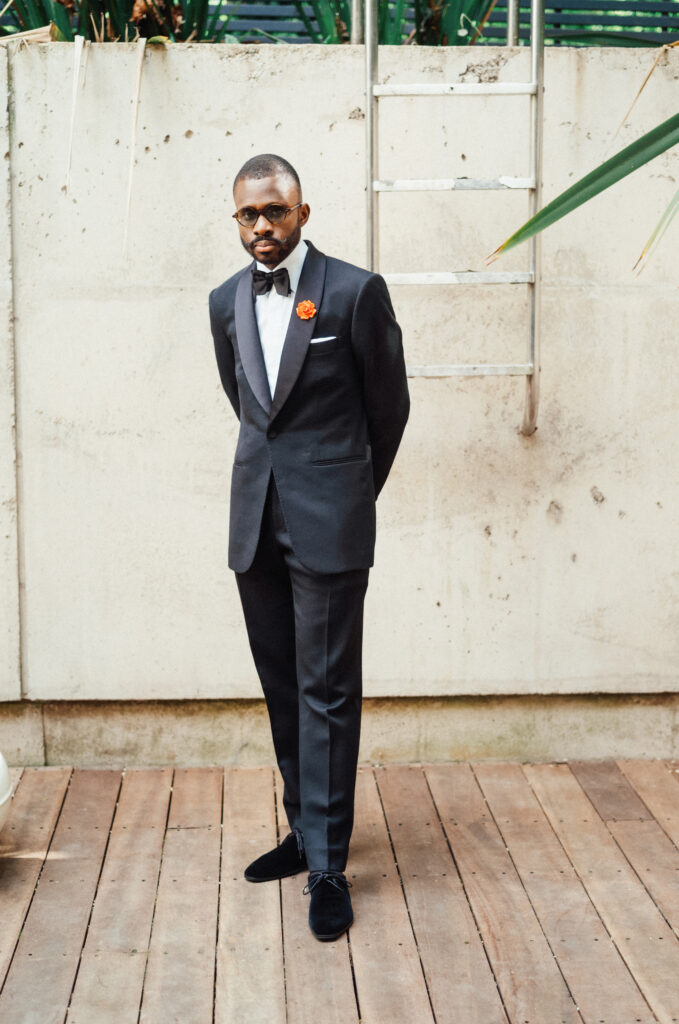
Lapel style. Peak lapels are the sharpest, most formal choice, and the most flattering on almost every build - they draw the eye up and out, broadening the shoulder line. Shawl lapels are softer and rounder, with an old-Hollywood elegance; they're the most traditional dinner-suit lapel and pair beautifully with a single button. Notch lapels are technically a business-suit detail and, in our view, have no place on a proper dinner suit. A small thing that separates a considered black tie wardrobe from a rented one.
Facing. Lapels are traditionally faced in silk — satin for a bright, reflective finish, or grosgrain (ribbed silk) for a more matte, textured look that photographs beautifully and shows less wear over time. We cut most of our bespoke lapels in grosgrain for exactly this reason.
Fabric. Barathea — a fine, closely woven wool with a subtle pebbled texture — is the traditional cloth of choice, in weights typically between 11oz and 14oz depending on the season and the wearer. Increasingly, we're also cutting in wool-mohair blends for a sharper drape and a slight sheen, and in silk moiré for men who want something genuinely singular. Colour is almost always midnight navy or black — midnight navy, in fact, reads blacker than black under artificial evening light, which is why it's the more sophisticated choice among people who know.
Silhouette. Single-breasted with one button is the modern default and the most versatile; double-breasted, worn always buttoned, is bolder and works particularly well on a taller frame. Pockets should be jetted (no flap), and trousers should have a satin stripe down the outer seam with no turn-ups. S small detail, but one of the fastest ways to spot a suit that wasn't properly considered.
Beyond the dinner suit. Depending on the occasion and your own taste, a smoking jacket or a velvet jacket can be a superb alternative to the classic dinner suit — richer in texture, more personal, and increasingly popular for private members' clubs and less strictly formal black-tie events. We cut these with the same historical accuracy as our dinner suits, so you can wear something distinctive without it reading as fancy dress.
Made-to-Measure vs Bespoke vs Off-the-Peg
Off-the-peg dinner suits are made in standard sizes and simply hemmed to fit. They're the fastest and cheapest route, but the proportions (shoulder width, sleeve pitch, jacket length) are fixed. For most men, this is where black tie starts feeling like a costume rather than an outfit.
Made-to-measure starts from a master pattern that's then adjusted to your individual measurements and fit preferences. This is where la Bowtique's elevated Made-to-Measure service sits: you get a garment built around your body, your posture, and the specific way you want it to sit — without the multi-fitting timeline of full bespoke.
Bespoke, in the strictest sense, means a pattern cut from scratch for you alone, refined across multiple fittings. It's the highest level of personalisation and the longest process.
For the vast majority of men commissioning a dinner suit, made-to-measure is the right balance of fit, craftsmanship, and turnaround, which is why it's the foundation of our black tie tailoring service.
Why Commission Black Tie Tailoring With la Bowtique
We didn't start as tailors, we started as bow tie makers, supplying Savile Row houses and private clients since 2011. That means our tailoring service was built from the accessory outward: we understand how a bow tie sits against a collar, how a cummerbund should meet a waistband, how a pocket square should echo (never match) a lapel, before we ever cut a jacket. Every dinner suit we make is designed to work as a complete outfit, not just a garment.
Mickael, our founder, personally consults on every commission. He has spent years sourcing cloth directly from mills in Italy and the UK, from silks to barathea to mohair blends, so the fabric options you're shown aren't a generic swatch book, but a curated selection chosen for black tie specifically. And because he wrote Modern Black Tie, he can tell you not just what looks good on you, but why it's historically correct and where you have genuine room to make it your own.
How the Commissioning Process Works
- First contact. Reach out via WhatsApp, email, or Instagram to start the conversation. We see clients at our showroom or elsewhere in central London, and for clients further afield, we offer worldwide travel for consultations.
- Initial consultation. You'll try on master garments, discuss fit and style preferences, and work through fabric and detailing choices directly with Mickael. This is where lapel style, cloth weight, silhouette, and accessories all get decided.
- Final fitting. Your dinner suit is ready within 6-8 weeks. Mickael checks the fit in person and makes any adjustments needed, typically completed within 10 days.
- Future commissions. Once you've been through the process once, ordering again is simple — your measurements and preferences are on file, so a new dinner suit, smoking jacket, or velvet jacket can be commissioned without a repeat fitting.
Full details are on our dedicated process page, and you can browse fabric and style options in our tailoring catalogue.
Finishing the Black Tie Outfit
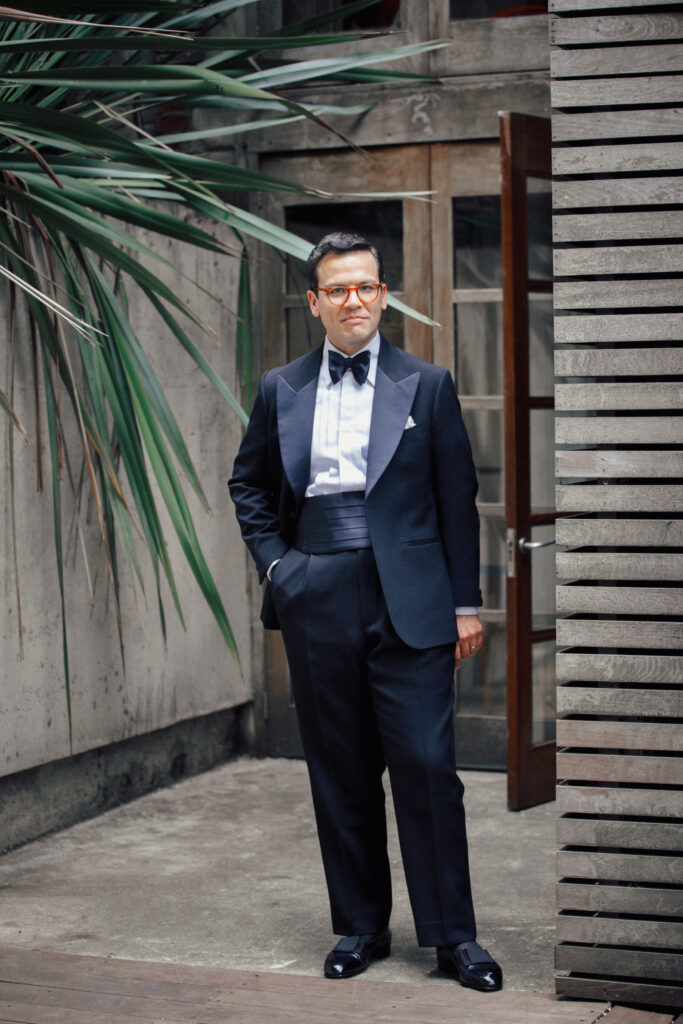
A commissioned dinner suit deserves accessories to match. A silk bow tie (self-tie, always) in satin or grosgrain to complement your lapel facing. A cummerbund to cover the waistband. Silk socks, calf-length, so no skin shows when you sit down. A white pocket square, folded simply. Braces, since a proper dinner suit trouser doesn't have belt loops, therefore no belts allowed. You'll find our full range under Bow Ties and Accessories.
Frequently Asked Questions
What's the difference between a dinner suit and a tuxedo? Nothing. "Dinner Suit" is the British term, "Tuxedo" the American one. Same garment, same dress code.
How long does a made-to-measure dinner suit take? Typically 6–8 weeks from your initial consultation to final fitting, with any alterations completed within 10 days after that.
Can I commission a dinner suit if I'm not based in London? Yes. We offer virtual consultations for international clients. Tried and tested formula. Get in touch and we'll arrange a convenient time to call.
Black or Midnight Blue; which should I choose? Always go Black. Midnight Blue is a good alternative, and has good merits, however, we always advise to stick to classic black.
Do I need a waistcoat or a cummerbund? One or the other, never both, and never neither. The waistband of a dinner suit trouser is always meant to be covered.
Ready to Commission Your Dinner Suit?
Get in touch with Mickael on WhatsApp or contact@labowtique.com to arrange your first black tie tailoring consultation.